How Long Does SEO Take to Show Results?
Expect meaningful changes in three to six months, longer for a new site in a competitive subject. But results don't arrive all at once — crawled, indexed, appearing deep in results, position improving, first clicks, steady traffic.
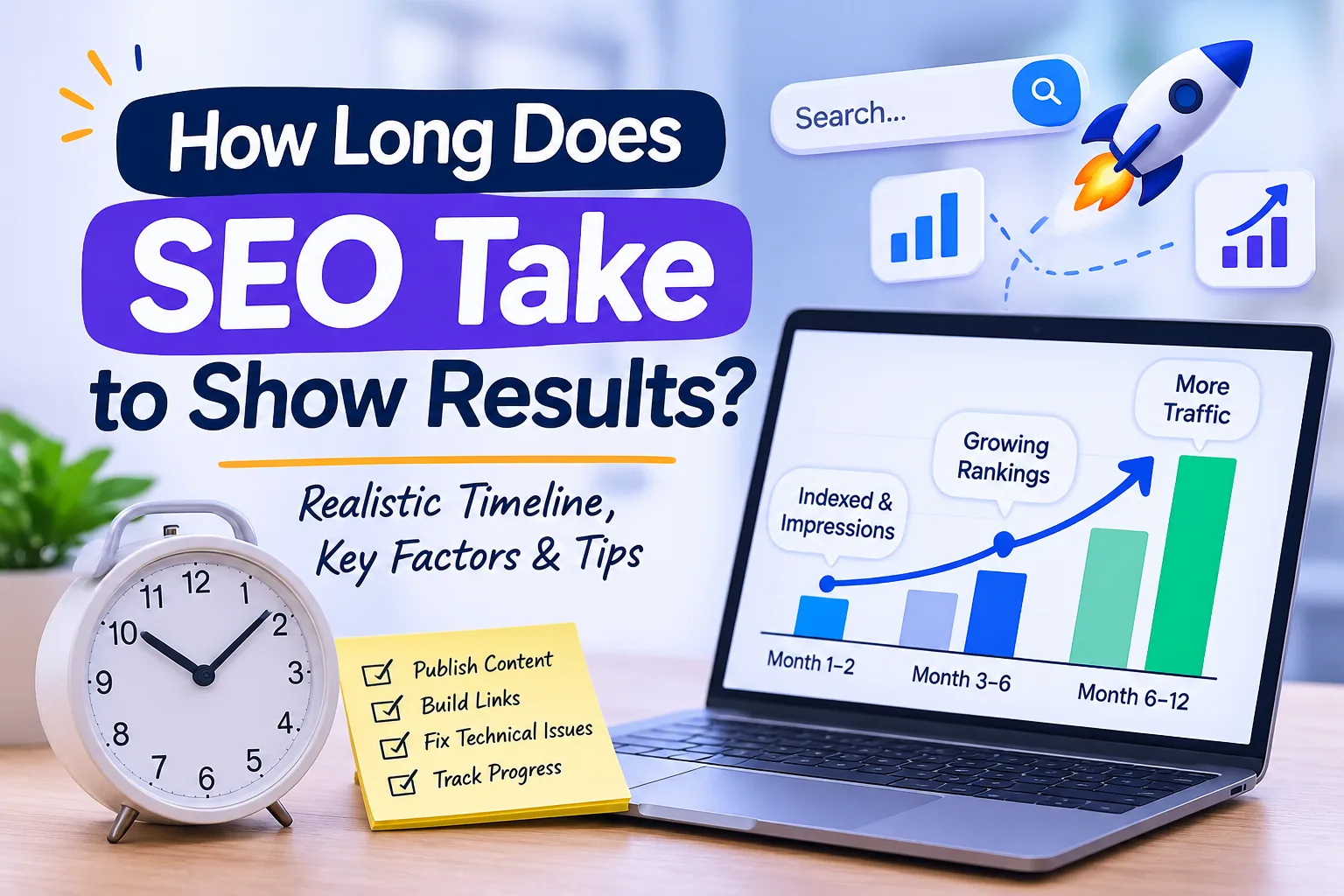
If you're waiting for SEO results, expect to see meaningful changes in three to six months. A brand-new website in a competitive subject can take longer. A specific, low-competition long-tail keyword can start showing signs of progress much sooner.
There isn't a reliable number of days or months that applies to every website. Anyone promising that your rankings will arrive on a specific date is guessing.
SEO results also don't appear all at once. Your page might be crawled first. Then, it gets indexed. Finally, it may show up in search results, likely far down. After that, its position may slowly get better. Then, you'll notice regular clicks and traffic.
That slow progress can make SEO seem stagnant. But in reality, your site is advancing.
SEO Results Usually Come in Stages
One of the easiest ways to understand SEO is to stop thinking about rankings as an on/off switch.
A new page generally goes through a progression like this:
Crawled → Indexed → Appearing deep in results → Position improving → First clicks → Steady traffic
Each stage can take a different amount of time.
For example, Google might crawl and index your article fast. But that doesn't mean it will show up on the first page right away.
You might find your article sitting around position 50, 70, or even lower.
This still shows that Google understands the page. It means the page has a spot in the search results. The problem is simply that very few people are going to scroll that far to find it.
This is why checking only traffic can give you the wrong impression.
If your article has moved from nowhere to position 65, that's movement. It just isn't useful traffic yet.
Why Impressions Come Before Clicks
An impression means your page appeared in a search result and was shown to a searcher.
It doesn't mean they clicked it.
This distinction matters a lot when you're looking at Google Search Console.
Imagine your article appears for a keyword at position 60. It can receive impressions without generating a single visit. That's completely normal.
As the page gets closer to the top, the chances of getting clicks usually go up. The click-through rate can change a lot. It depends on search intent, device, query, SERP features, brand recognition, and position.
To simplify, a result near the top of page one gets many clicks. But a result far down may only get a few.
A page can get 1,000 impressions and still rank around position 60. If it gets zero or very few clicks, that doesn't mean the SEO has failed.
The first question should be:
Where is the page appearing?
Not simply:
How many people clicked it?
What Can Make SEO Results Come Faster?
Some websites gain traffic faster. They help search engines grasp what each page is about.
Target Specific Questions
A new website usually has a harder time competing for broad terms with established sites.
Instead of targeting something extremely broad, you can start with specific questions.
A new hosting website might do better with a specific question about VPS resources. This is more effective than using a general term like "web hosting."
Specific searches usually have fewer potential competitors, although difficulty varies by keyword.
The idea isn't to avoid competitive keywords forever.
It's to build visibility where you have a realistic opportunity first.
Publish Consistently
You don't need to publish dozens of articles overnight.
A small group of useful articles can be more helpful than a big set of shallow pages published all at once.
Consistency also gives you more opportunities to appear for different searches.
Over time, internal links can help those pages support each other. This builds a stronger topical structure.
Use Internal Links
Internal links are easy to overlook.
When you publish an article, find older pieces that answer a related question.
For example, an article about website performance can connect to Your Site Is Slow — Is It the Host or Your Site?
This helps readers find related information. It also gives search engines context about how your pages connect.
Get the Technical Basics Right
You don't need a technically perfect website before SEO can work.
But the basics shouldn't be broken.
Your pages should be:
- Accessible to search engines
- Indexable
- Mobile-friendly
- Using a clear canonical version
- Reasonably fast
- Free from major technical issues that prevent crawling or indexing
Fixing a serious technical problem can make a big difference.
Fixing a tiny technical detail usually won't suddenly move an article from page six to page one.
What Can Make SEO Take Longer?
SEO tends to move more slowly when you're starting with several disadvantages at once.
A Brand-New Domain
A new website has little history and usually fewer websites linking to it.
That doesn't mean Google won't rank it.
You shouldn't expect a new site to compete with those that have shared valuable content for years.
Competitive Keywords
This is one of the biggest factors.
Two articles can be well written but may take different times to rank.
Targeting a specific question with low competition can lead to quick results. Trying to target a valuable keyword held by established sites can take a lot longer.
The effort is the same.
The competition isn't.
Thin Content
Publishing five short pages that don't answer much doesn't build a strong SEO foundation.
A useful article should actually solve the question it targets.
It should also fit into the wider subject covered by your website.
A site with a few unrelated pages may struggle to build depth. In contrast, a site with related articles can support each other better.
Technical Problems
Sometimes the problem isn't that SEO is slow.
The page simply isn't being indexed.
If search engines can't access your content, they can't index it. Adding more articles won't solve this issue.
Check the indexing status before assuming you need more time.
Keyword Difficulty Matters More Than Effort
It's easy to think that working harder should automatically produce faster rankings.
SEO doesn't quite work that way.
You can spend weeks on a great article, but if stronger sites own the keyword, it may take a long time to rank.
That's why a new website often benefits from starting with specific questions.
When those pages get impressions, clicks, and links, they help the site. Returning visitors also boost the overall structure.
Eventually, you can work toward more competitive subjects.
Build a strong foundation first. Don't rush to the hardest keywords.
Does Site Speed Change the Timeline?
Site speed matters, but it's often given more credit than it deserves.
A very slow website can create usability problems and technical issues. Improving it is worthwhile.
Speeding up a page won't guarantee it ranks higher. Better content, more relevance, and higher authority matter more.
Is your hosting causing your website to be slow? covers the difference between server-related and website-related performance problems.
Technical health should be part of your SEO work.
It just shouldn't be the entire strategy.
What Should You Measure While You Wait?
Don't sit around for six months and then check whether SEO worked.
Watch the smaller signals along the way.
Pages Indexed
First, check whether your important pages are actually indexed.
Publishing more content is not useful if your current pages aren't indexed by Google.
Impressions
Impressions are often one of the first useful signs of organic visibility.
If a page starts with zero impressions and then gets a few dozen, and later a few hundred, something is changing. This is true even if the traffic still seems low.
Average Position
Average position can show movement before clicks become significant.
A page moving from position 80 to 45 hasn't reached the first page, but it has clearly moved.
Don't expect every query to improve at the same speed.
The Queries You Actually Appear For
This one can be surprisingly useful.
You might write an article for one keyword, but Google can show it for other related questions you didn't think of.
These queries can spark ideas to enhance the article or develop supporting content.
When Should You Actually Worry?
Slow progress isn't necessarily a problem.
But there are situations where you should investigate rather than simply wait.
For example:
- Important pages still aren't indexed after several weeks.
- A page receives absolutely no impressions over an extended period.
- Organic visibility consistently declines for months.
- Multiple pages suddenly disappear from search.
- Search Console shows indexing or technical problems.
- Your content isn't matching the search intent of the keywords you're targeting.
These are different from a page simply taking time to move from position 70 to position 30.
SEO takes time, but "just wait longer" won't fix a technical or strategic issue.
A Realistic SEO Timeline
The following is a typical pattern, not a guarantee.
| Period | What may happen | What you should do |
|---|---|---|
| Month 1–2 | Pages are crawled and indexed. Some may begin appearing for low-ranking queries. | Check indexing, fix technical issues, and keep publishing useful content. |
| Month 3–6 | Impressions may increase. Some pages can begin moving toward more visible positions and generating initial clicks. | Improve pages that are getting impressions, strengthen internal links, and study actual search queries. |
| Month 6–12 | Established pages may generate more consistent impressions and traffic. Some competitive terms may still take longer. | Continue building useful content, update existing pages, and work gradually toward more competitive topics. |
A new site can move faster or slower than this.
A low-competition keyword might show meaningful results quickly. A competitive commercial keyword could take considerably longer.
That's why the timeline should be treated as a range, not a promise.
How Long Should You Wait Before Changing Your SEO Strategy?
Don't change your entire strategy because an article hasn't ranked after a few weeks.
First look at what the data says.
If impressions are up, the page is indexed, and its average position is improving, there's no need to stress.
If several months pass with no impressions or rankings, check for indexing issues. It's time to investigate.
You may need to change the keyword. Improve the content and fix technical issues, too. Strengthening internal linking can help. Also, reconsider the search intent.
The goal isn't to wait blindly.
It's to give the work enough time to produce evidence, then use that evidence to decide what to change.
What About Backlinks?
Backlinks can boost a page's and website's authority. However, they don't guarantee when rankings will improve.
Getting a large number of links doesn't automatically make a page rank tomorrow.
Links are important. The relevance and quality of links can vary. Competitive topics often need stronger signals than less competitive ones.
For a new website, start with a solid foundation. Focus on useful content, a clear site structure, internal links, and technical accessibility.
Is No Traffic in the First Few Months Normal?
It can be.
A new website might spend its first months gathering impressions. It may show up in low positions until real traffic starts to grow.
That doesn't mean you should ignore zero traffic.
Check whether pages are indexed and whether impressions are appearing. If both are happening, the site may simply be early in the process.
If there are no impressions, check into it before thinking you just need more patience.
What About the Rest of the Website?
SEO doesn't happen in isolation on one article.
Your domain and hosting matter. So does your website setup. Content quality is important too. Lastly, technical health shapes your page environment.
Running a WordPress website costs money. This is different from how fast it ranks. However, knowing your site's needs helps you make smart choices. How Much Does a WordPress Site Actually Cost Per Year? explains the different costs that can come with running a WordPress site.
Hosting choices can impact technical performance. Also, your domain's status affects whether your website stays accessible over time.
When you compare infrastructure options, look at Shared Hosting vs VPS vs Dedicated. These terms show how each hosting model is different.
Likewise, your domain's status can affect whether your website remains accessible over time. If you're dealing with domain expiration or want to understand what happens when a domain reaches its expiry date, see What Happens When a Domain Expires?
The Bottom Line
So, how long does SEO take to show results?
For many websites, three to six months is a good timeframe for seeing progress, but it's not a strict deadline. New websites in tough markets may take longer to grow. In contrast, low-competition searches can show progress more quickly.
The most important thing is to understand what "results" actually means.
First, your page needs to be crawled and indexed. Then it needs to appear for relevant searches. Its position needs to improve enough for people to see it. Only then do clicks and steady traffic become realistic.
If your impressions are up and your positions are getting better, don't see slow progress as failure.
SEO is less like flipping a switch and more like watching a line move in the right direction. Sometimes the movement is obvious. Sometimes you need to look closely at the data to see it.
Provider Disclaimer
This article is for general educational and informational purposes. Provider and product names mentioned here are just examples. They are not endorsements or recommendations. Nobody pays to be named here.
Common questions
How long does SEO take to show results?
SEO usually takes about three to six months to show results. However, there isn't a set timeline for everyone. A new website in a tough field might take longer to rank. A page that focuses on a specific, low-competition query can quickly get impressions. It can also improve its ranking faster.
Why does my site get impressions but no clicks?
Impressions only mean your page appeared in search results. If it is ranking at a low position, very few people may see it, let alone click it. Check the average position for the queries generating impressions. If the page is buried deep in results, zero or very low clicks can be completely normal.
How long does it take Google to index a new page?
There isn't a fixed indexing time. Some pages can be discovered and indexed quickly, while others take longer. Internal links affect discovery. Crawl accessibility plays a role too. Website structure matters. The page itself also impacts how easy it is to find. If a page stays unindexed for a long time, check Search Console. Don't just wait.
Can SEO work faster for a new website?
Yes, but you shouldn't expect a new website to compete immediately for every keyword. Focusing on specific long-tail questions can help you gain visibility faster. Publish useful content regularly. Build smart internal links and keep your technical setup clean. This strategy could work better. It's often smarter than diving into tough terms right away.
How many articles do I need before SEO works?
There is no magic number of articles that makes SEO start working. Five genuinely useful articles can be more valuable than fifty thin ones. What matters is if your content matches what your audience looks for. It's also important that related pages support each other. Focus on developing depth for your site's main topics. Don't worry about hitting a specific article count.
Does site speed affect how fast I rank?
Site speed matters a lot. This is true if a website has big performance or usability problems. However, it won't guarantee better rankings. A faster page doesn't automatically outrank a more relevant and authoritative competitor. Fix major speed and technical issues. Just boosting performance won't fix tough keyword competition. You need more than that.
Why is my position getting worse instead of better?
Search rankings can move in both directions. Competitors add new content. Search results change. Google then reconsiders which pages best match a query. A temporary drop doesn't necessarily mean something is wrong. Examine the trend over time. See if impressions, relevant queries, and overall visibility are changing too.
How long should I wait before changing my SEO approach?
Don't completely change your strategy just because a page hasn't ranked after a few weeks. First check whether it's indexed and receiving impressions. If low visibility goes on for months, check keyword difficulty, search intent, content quality, internal linking and technical setup. Then decide what needs to change.
Do backlinks speed up SEO results?
Backlinks boost a site's authority and help pages rank in tough searches. However, they won't guarantee quick rankings. A backlink also isn't automatically valuable just because another website links to you. Create helpful content and earn relevant links naturally. Don't view backlinks as a quick fix.
Is it normal to get no traffic in the first few months?
It can be normal for a new website, particularly when it targets competitive topics. A better question is whether you notice early signs. Look for indexing, impressions, or slow ranking changes. If things stay at zero for too long, check for technical and content issues. Don't just wait, thinking it will resolve itself.
How do I know if my SEO is working?
Look beyond total traffic. Check if key pages are indexed. Look for rising impressions and improving average positions. Identify which queries are boosting visibility. SEO changes often show up in Search Console first. You might not see them in website traffic right away. A page moving from very low positions into more visible results is a useful signal.
Can I pay to rank faster?
You can't simply pay Google to give an organic page a higher ranking. Paid search advertising shows ads to searchers. Organic SEO is different. Be careful if someone promises a guaranteed organic ranking in a few days just because you paid them. SEO doesn't have a guaranteed timetable.