Why Did My Hosting Renewal Price Triple?
You signed up at $3 or $4 a month and the renewal invoice is two, three or even four times higher. The invoice probably isn't a mistake. Here is why it happens, and what you can actually do about it.
You signed up for hosting at a price that looked reasonable. Maybe it was $3 or $4 a month. Then the renewal date arrived, and suddenly the invoice was two, three, or even four times higher.
If that happened to you, the first thing to know is that the invoice is not necessarily a mistake.
Many hosting companies offer introductory pricing. This means the first term is a big discount, but the service renews later at the regular price.
Prices checked on 31 August 2026 showed some shared hosting plans. Initially, they ranged from about $2.99 to $6.99 per month. At renewal, the prices jumped to around $9.99 to $29.99 per month. In some cases, that makes the renewal price more than four times the original monthly figure.
So why does this happen, and what can you actually do about it?
The Price You Saw Was Probably an Introductory Rate
The large number on a hosting pricing page is often the promotional rate.
The important number is the smaller one that says something like "renews at".
The introductory price normally applies for a specific period. That could be 12, 36, or 48 months depending on the plan and the term you selected. After that period, the hosting account will change. It will then use the provider's regular renewal price.
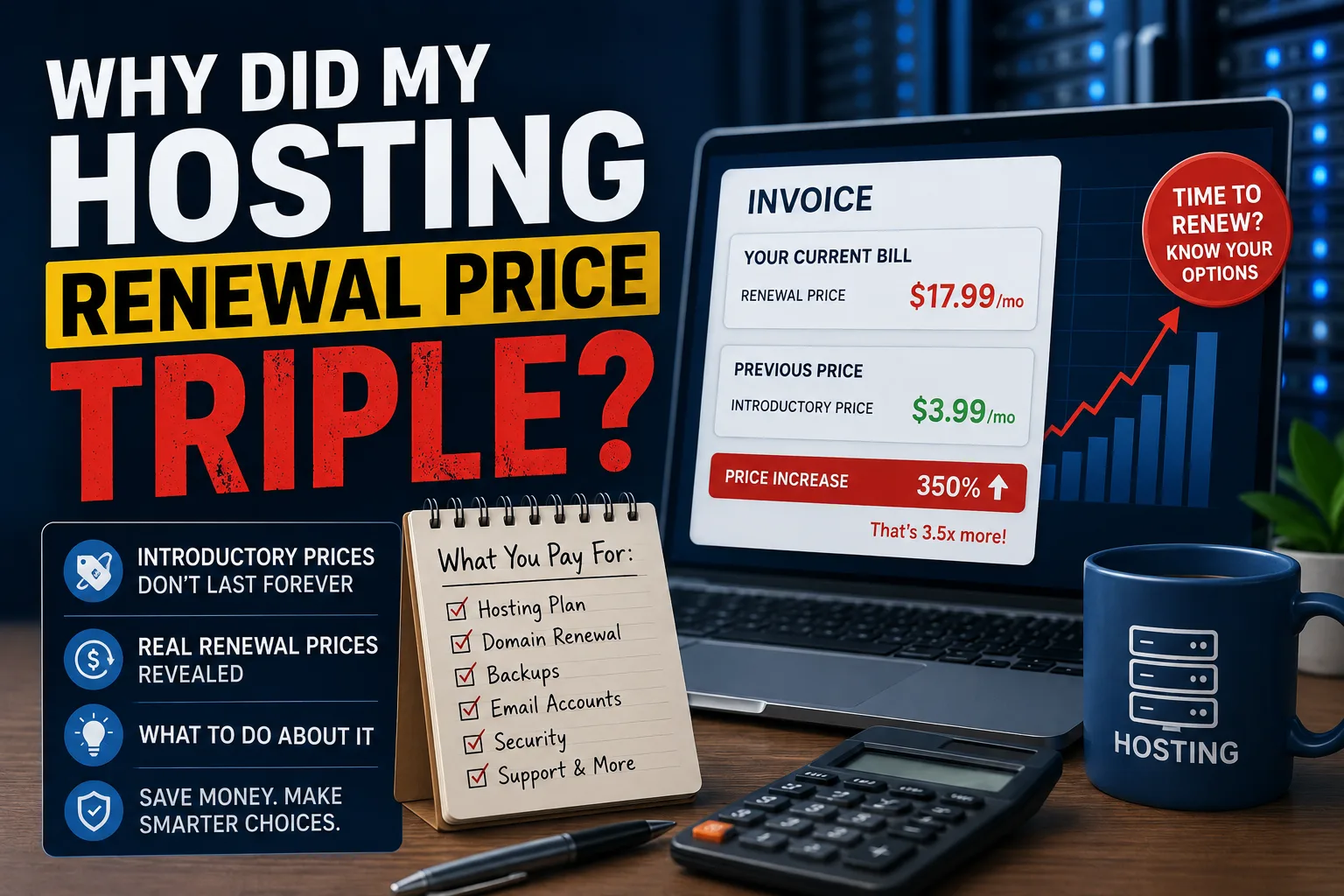
This is why a plan can appear to cost $3.99 per month when you first buy it but later renew at $17.99.
Nothing has necessarily changed about the server.
The discount has simply ended.
Why Do Hosting Companies Use This Pricing Model?
There is a straightforward business reason.
Getting a new customer costs money. Hosting companies spend money on advertising, sales, infrastructure and customer acquisition. An introductory price draws in people. They are comparing different hosting providers.
Some customers are expected to stay for years after the initial discount ends.
And moving a website isn't always something people want to deal with.
You might need to move website files, databases, and email accounts. Also, update DNS records and ensure everything works smoothly. If all goes smoothly, paying a higher renewal price might feel easier than migrating.
The renewal price is therefore not necessarily a punishment for staying. It is usually the standard price of the service after the promotional period ends.
Why Does the Price Sometimes Triple or Quadruple?
The size of the increase depends on how heavily discounted the original price was.
Here are some examples from prices checked on 31 August 2026:
| Plan example | Signup price | Renewal price | Increase |
|---|---|---|---|
| Hostinger Premium | $2.99/mo | $10.99/mo | 3.7x |
| Hostinger Unlimited | $3.99/mo | $16.99/mo | 4.3x |
| Bluehost Starter | $3.99/mo | $9.99/mo | 2.5x |
| Bluehost Business | $6.99/mo | $13.99/mo | 2.0x |
| SiteGround StartUp | $3.99/mo | $17.99/mo | 4.5x |
| SiteGround GrowBig | $6.69/mo | $29.99/mo | 4.5x |
These figures show pricing as it was when checked. They do not rank hosting companies or suggest buying any specific plan.
The other thing worth noticing is the length of the introductory term.
A four-year deal may look cheaper because the discounted price lasts longer. You also end up paying for years of hosting before you find out the provider's renewal price.
Don't Forget the Other Charges
Sometimes the hosting plan isn't the only thing that renews.
Your original package may have had free or discounted extras during the first term.
A domain name is a common example. Some hosting plans offer a free domain for the first year. After that, the domain renews at the usual registration price. That renewal follows the domain's own billing cycle.
You may also see charges for things such as:
- Domain renewal
- Website backups
- Professional email
- Malware scanning
- Dedicated IP addresses
- Premium security features
- Additional storage
So if your invoice looks much higher than expected, don't look only at the hosting line.
Check the entire invoice.
Should You Just Pay the Higher Renewal Price?
Not automatically.
Start by asking yourself whether the service has actually been good.
Has your website been reliable?
Has support helped when you've had a problem?
Has the website been reasonably fast?
If the answer is yes to all three, the higher renewal price may still be reasonable. The cheapest hosting isn't necessarily the best value if moving creates problems.
This is worth saying plainly: a high renewal price doesn't mean the hosting company is bad. Similarly, a low introductory price doesn't guarantee a company is good.
Can You Negotiate Your Renewal Price?
Sometimes.
Before you cancel, reach out to support. Explain that your renewal price is much higher than what you paid before.
Ask whether they can offer:
- A renewal discount
- A retention offer
- A shorter promotional extension
- A different plan
- A lower-cost billing option
There is no guarantee that they'll reduce the price, but asking costs very little.
If you want to stay with the same provider, this should be your first step.
Would Moving to Another Host Save Money?
It can, but there is a catch.
A new hosting company may offer you another introductory rate. That can make switching look extremely attractive.
But eventually, that promotional period ends too.
You might switch from a provider with an $18/month renewal to one at $4/month for the first year. But be ready for another price hike later.
So don't compare your current renewal price against someone else's introductory price.
Compare the normal price you'll eventually pay.
Considering leaving shared hosting as your site grows? Check out our Shared Hosting vs VPS vs Dedicated guide. It explains the differences between shared, VPS, and dedicated hosting.
What If You Don't Want to Pay the Renewal?
Don't simply ignore the invoice.
Hosting accounts can move through different stages after a missed payment. Depending on the provider, the service may have a short grace period. After that, it can be suspended and eventually terminated, leading to data deletion.
The exact timing varies between providers.
If you're planning to move, take a complete backup before the renewal date. Waiting until the account is suspended can make it harder to access your files and database.
Your domain also has its own renewal process. An expired domain may go into a redemption period. Recovering it then can cost much more than a regular renewal.
How Can You Avoid a Big Renewal Surprise?
The easiest solution is to check the renewal price before you buy.
Don't stop at the large promotional number.
Look for the price that applies after the introductory term.
If you can't find it, check the checkout page or ask the provider's pre-sales team directly:
"What will I pay when this plan renews?"
Also check how long the promotional price lasts.
A $3.99 plan for 12 months and a $3.99 plan for 48 months may look the same, but the commitment differs a lot.
It's also worth putting your renewal date in your calendar about a month ahead. Automatic renewal is great if you want to keep your service. But it can be a surprise if you didn't expect the charge.
What About Changing Your Hosting Plan?
A renewal invoice can also be a good time to ask whether you still need the plan you're paying for.
You might have bought a larger package, thinking your website would grow. But traffic never got that high.
In that case, moving to another provider isn't necessarily the only solution.
You could simply downgrade.
If your site has outgrown shared hosting, switching to a VPS might be a better choice. Visit our VPS hosting section to see how a virtual private server can help.
If you're thinking about dedicated hardware, our guide on what a dedicated server actually costs explains why the advertised monthly price isn't always the final cost.
Think About the Three-Year Cost
Looking at one month's bill can be misleading.
Suppose your hosting renews at $17.99 per month. Over three years, that is about $648 just for hosting.
A new introductory plan costs about $4 a month. This adds up to around $144 over the year. But switching plans takes time and might need several migrations.
This is where a longer-term comparison becomes useful.
Our hosting cost calculator helps you compare hosting costs. It considers monthly pricing, setup fees, and the value of your time.
The cheapest monthly number isn't always the cheapest overall option.
The Simple Way to Look at Hosting Renewals
A hosting renewal price that is three or four times higher can look shocking when you first see the invoice.
The reason is simple: you were on a promotional rate, and it has ended.
The important part is what you do next.
Check the full invoice. Look at your domain and other services. Ask the provider whether they can offer a better renewal rate. Compare the regular prices of alternatives. Don't just look at one company's renewal price and another's introductory offer.
And if you decide to move, back up your website before the old account is suspended.
Most importantly, check the renewal price before signing up next time.
Spending a few minutes on the pricing details can save you from a nasty surprise later on.
Common questions
Is a hosting renewal price increase normal?
Yes. Many hosting companies offer low prices for new customers. After the promo ends, they switch to their regular rates. The renewal price usually appears in the provider's pricing details or terms.
Why is my hosting renewal three times more expensive?
Your original price was probably an introductory discount. Once the discount expires, your account switches to the provider's standard rate. This rate can be two, three, or even four times the original price.
Can I negotiate my hosting renewal price?
Sometimes. Contact the provider before you cancel. Ask if they can give you a retention discount, an extension, or a cheaper plan.
Should I switch hosting providers when my price increases?
Not automatically. First, check the renewal price against normal prices of alternatives. Think about how reliable your current provider is. Also, consider the support and performance you've received.
Will a new hosting provider give me the same introductory price forever?
Usually not. Promotional prices usually last for a set time. After that, the account renews at the provider's regular rate.
How can I find my hosting renewal price before buying?
Look for a line showing the renewal rate on the pricing page or checkout screen. If you cannot find it, ask the provider directly what you will pay after the introductory period.
Can I change from yearly billing to monthly billing?
Many providers offer monthly billing, although the monthly rate may be higher. Monthly billing gives you more flexibility. You don't have to commit long-term.
What happens if I don't pay for my hosting renewal?
The provider decides if and when to suspend the account. Then, they may terminate it. If you plan to leave, back up everything first. Your account may become inaccessible.
Does my domain renew at the same price as my hosting?
Not necessarily. Domain registration is often a separate service. It has its own renewal price and billing date. This is true even if the domain was free during the first hosting term.
How can I avoid a high renewal bill in the future?
Check the renewal price before you buy. Also, note how long the promotional rate lasts. Add the renewal date to your calendar. Also, check your hosting needs before automatic billing occurs.